How to Start a Medical Practice: A Complete Startup Checklist for Physicians
How to start a medical practice is one of the most important questions physicians face when considering independent practice ownership. Opening a clinic creates opportunities for greater professional independence, but it also introduces business, financial, legal, and operational responsibilities.
Clinical experience alone does not prepare a physician for every aspect of launching a healthcare business. A new practice also needs appropriate licensing, a realistic financial plan, reliable technology, administrative workflows, and a clear approach to patient access.
Moreover, healthcare businesses operate within a complex regulatory environment. Requirements can vary by state, specialty, ownership structure, and services offered. Therefore, physicians should establish the right legal and operational foundation before making major financial commitments.
A practical how to start a medical practice checklist helps organize these responsibilities into manageable steps. Instead of addressing every challenge at once, practice owners can establish priorities, identify dependencies, and prepare for a more controlled launch.
This guide explains the essential steps involved in opening a medical practice in the United States. It covers business planning, legal structure, startup expenses, professional requirements, insurance participation, technology, staffing, and daily operations.
In addition, it explores how a healthcare Management Services Organization (MSO) can support the non-clinical infrastructure surrounding a physician-led practice.
How to Start a Medical Practice: 12 Essential Steps
Starting a medical practice involves several connected decisions. Although the exact process varies, most physicians need to address a common set of business and operational requirements.
The core steps include defining the care model, creating a business plan, establishing the legal structure, developing a budget, completing licensing requirements, preparing payer relationships, and building the operating environment.
However, these activities do not always happen in a simple sequence. For example, payer enrollment may depend on finalized practice information, while selecting a location may affect licensing, technology, and staffing decisions.
Consequently, a successful startup plan should identify which activities can proceed together and which require earlier decisions to be completed.
The following sections explain how to approach each stage without overlooking the infrastructure needed to support patient care.
1. Define Your Clinical Model and Target Patients
Before registering a business or signing a lease, physicians should decide what type of medical practice they intend to build.
For example, a primary care clinic has different operating requirements from a specialty practice, a preventive medicine clinic, or a telehealth organization.
Likewise, a physician operating independently may need a different administrative structure from a medical group planning to recruit additional clinicians.
Start by answering these questions:
- Which medical services will the practice provide?
- Who is the intended patient population?
- Will services be delivered in person, virtually, or through a hybrid model?
- Will the practice accept insurance, offer self-pay services, or use a combination?
- Which clinical professionals will deliver care?
- What equipment, facilities, and support services will be required?
- Will the practice operate from one location or eventually expand?
These decisions influence almost every later startup expense and administrative requirement.
For instance, a clinic providing in-office procedures may need specialized equipment, appropriate facility arrangements, and additional operational protocols.
Meanwhile, a telehealth-focused practice may place greater emphasis on secure technology, virtual scheduling, and state-specific professional requirements.
Therefore, defining the clinical model early helps prevent unnecessary purchases and operational changes later.
2. Write a Medical Practice Business Plan
A business plan translates a physician’s clinical vision into an operating strategy.
Although business plans vary in length, a useful plan should explain how the practice will attract patients, deliver services, manage expenses, and generate enough revenue to support ongoing operations.
Important components include:
- Practice overview: Specialty, services, ownership, and clinical model.
- Market assessment: Target patients, local demand, and competing providers.
- Service strategy: Planned appointments, procedures, and care programs.
- Revenue model: Insurance billing, self-pay arrangements, or other lawful payment structures.
- Startup budget: Initial expenses and available financing.
- Operating plan: Staffing, scheduling, technology, and administrative processes.
- Financial projections: Expected expenses, collections, and cash flow.
- Growth plan: Future providers, service lines, or locations.
In addition, the plan should identify important assumptions.
For example, a projected patient schedule is not the same as collected revenue. Actual financial performance depends on appointment completion, payer arrangements, patient payments, expenses, and other variables.
Therefore, physicians should develop conservative financial scenarios rather than relying entirely on an optimistic launch forecast.
El U.S. Small Business Administration provides official guidance on business structures, registration, permits, banking, and other startup requirements.
Although medical practices have additional healthcare-specific obligations, general business planning remains an important foundation.
How to Start a Medical Practice Legally
Choosing the right legal structure is one of the most consequential steps in establishing a medical practice.
Physicians may consider professional corporations, professional limited liability companies, or other structures permitted under applicable state law.
However, a standard business entity that works for a nonmedical company may not be appropriate for a physician practice.
Some states restrict the corporate practice of medicine or impose specific rules concerning professional ownership, management, and control.
In addition, healthcare arrangements may be subject to restrictions involving fee splitting, professional referrals, financial relationships, and clinical decision-making.
Therefore, physicians should consult a healthcare attorney familiar with the state where the practice will operate.
Establish the Appropriate Business Entity
First, determine which legal structures are permitted for the proposed practice. Next, review ownership requirements, management responsibilities, and applicable registration procedures.
The appropriate structure may depend on the physician’s specialty, business partners, state requirements, and intended operating model.
Obtain Tax Identification Information
After forming the entity when required, obtain the appropriate tax identification information.
El Internal Revenue Service provides an official process for obtaining an Employer Identification Number (EIN). The IRS also explains that eligible applicants can obtain an EIN without paying an application fee.
Separate Business and Personal Finances
In addition, establish appropriate business banking, accounting, payroll, and financial recordkeeping procedures.
Keeping financial records organized from the beginning can support tax reporting, expense monitoring, and future business planning.
Most importantly, legal and financial arrangements should preserve the professional independence required under applicable healthcare laws.
3. Estimate Medical Practice Startup Costs
Opening a medical practice requires an investment in both clinical and administrative infrastructure.
However, there is no single startup cost that applies to every physician. Expenses depend on specialty, location, staffing, facility requirements, equipment, and the practice’s operating model.
A small consultation-based practice may have different requirements from a clinic offering procedures, imaging, or specialized testing.
Therefore, the startup budget should reflect the actual services the organization intends to provide.
Common Startup Expense Categories
- Legal and business formation expenses
- Professional licensing and applicable registration fees
- Facility deposits, rent, and renovations
- Medical equipment and clinical supplies
- Electronic health record and practice management systems
- Computers, networking, and communication tools
- Professional liability and business insurance
- Employee recruitment and payroll
- Billing and administrative services
- Website development and patient communication
- Accounting and financial management
- Working capital for ongoing operations
In addition to initial purchases, physicians should estimate recurring monthly expenses.
For example, rent, payroll, software subscriptions, insurance, supplies, and administrative services may continue even when appointment volume is lower than expected.
Consequently, working capital should be treated as a major part of the financial plan rather than an optional reserve.
Understand the Practice Break-Even Point
A break-even analysis can help physicians estimate the patient volume required to cover operating expenses.
For example, consider a hypothetical practice with $45,000 in monthly fixed expenses and an average contribution of $150 per completed visit after relevant variable costs.
Under those simplified assumptions, the practice would need approximately 300 completed visits per month to cover those fixed expenses.
However, this is only an illustration, not an industry benchmark. Actual practices must account for their own reimbursement arrangements, service mix, compensation structure, expenses, and collection patterns.
Therefore, a financial advisor or healthcare accountant should help validate the assumptions before the physician makes major investment decisions.
How to Start a Medical Practice: Licensing and Identifiers
Professional licensing and administrative registration are essential components of opening a medical practice in the United States.
However, requirements vary according to the state, provider type, services offered, and organizational structure.
Physicians should identify which approvals apply before offering services or submitting claims.
Confirm Professional Licensure
First, verify that each clinician holds the appropriate professional license for the services and jurisdictions involved.
For example, a physician licensed in one state should not assume that the same license automatically authorizes medical practice in every other state.
Telehealth operations may also involve requirements connected to the patient’s location and applicable state law.
Obtain National Provider Identifiers
Next, determine the appropriate National Provider Identifier (NPI) requirements.
Individual healthcare professionals and eligible organizations may require different NPI types for applicable administrative transactions.
However, an NPI does not replace professional licensure, payer enrollment, or other required approvals.
Review Additional Registrations
Depending on the practice, additional requirements may involve controlled-substance registrations, laboratory certification, facility permits, or other regulatory approvals.
For example, practices performing certain laboratory testing may need to evaluate Clinical Laboratory Improvement Amendments (CLIA) requirements.
Therefore, physicians should create a service-specific registration checklist and verify requirements with the relevant authorities.
For practices planning Medicare participation, the Centers for Medicare & Medicaid Services provider enrollment guide explains the relevant NPI and enrollment process.
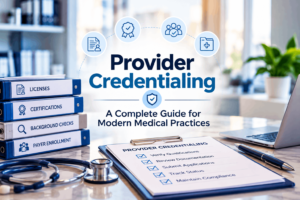
4. Complete Credentialing and Payer Enrollment
Physicians planning to accept insurance should begin evaluating payer participation early in the startup process.
However, professional credentialing, payer enrollment, contracting, and operational onboarding are not identical activities.
Each may involve different applications, supporting documents, approval procedures, and effective dates.
For example, a physician may have an active medical license but still need to complete credentialing and enrollment requirements before participating in a particular insurance network.
Important preparation steps include:
- Identifying target insurance networks
- Collecting professional licenses and certifications
- Maintaining accurate provider identification information
- Preparing relevant professional history
- Providing liability coverage documentation when required
- Completing applicable credentialing applications
- Reviewing participation agreements
- Tracking enrollment and contract effective dates
- Confirming billing readiness before submitting claims
In addition, organizations should maintain a centralized record of pending applications and outstanding requirements.
For Medicare participation, CMS uses systems such as PECOS for applicable provider enrollment activities.
However, approval timelines and requirements vary. Therefore, physicians should not assume that insurance participation will be available immediately after opening.
For a deeper explanation, read LHP’s provider credentialing guide.
5. Choose the Right Practice Location
A medical practice’s location can affect accessibility, patient demand, staffing, operating expenses, and future growth.
However, the best location is not necessarily the largest or most expensive property.
Instead, physicians should select a facility that supports their intended services and realistic patient volume.
Important considerations include:
- Patient accessibility and transportation
- Parking and building access
- Local zoning and permitted uses
- Exam rooms and clinical workspace
- Reception and patient waiting areas
- Privacy and confidential communication
- Accessibility requirements
- Storage and equipment needs
- Utilities and technology infrastructure
- Lease terms and future expansion options
In addition, practices should review whether the proposed space requires modifications to support applicable safety, accessibility, and clinical requirements.
For example, a procedure-focused clinic may require different physical arrangements from an office providing primarily consultations.
Therefore, physicians should confirm that a property can legally and practically support the planned services before making a long-term commitment.
6. Build Your Medical Practice Technology Stack
Technology is one of the most important operational decisions for a new medical practice.
However, selecting software should begin with an understanding of clinical and administrative workflows.
For example, a practice may need to connect scheduling, patient registration, clinical documentation, billing, payments, and reporting.
If those functions operate through disconnected systems, staff may spend additional time entering information or resolving inconsistencies.
Therefore, physicians should evaluate technology based on operational requirements rather than purchasing every available feature.
Core Technology Categories
- Electronic health record system
- Practice management and scheduling platform
- Patient registration and intake tools
- Secure patient communication
- Billing and payment administration
- Electronic prescribing where applicable
- Telehealth capabilities when needed
- Laboratory and referral workflows
- Financial and operational reporting
- Access management and security controls
In addition, organizations should assess vendor reliability, interoperability, training requirements, data access, and contractual obligations.
Healthcare information security also requires careful attention. Practices should evaluate applicable privacy and security responsibilities before implementing systems that handle protected health information.
Ultimately, the goal is not to build the most complicated technology environment. It is to establish a dependable system that supports providers and administrative teams.
7. Establish Compliance, Privacy, and Insurance Protection
Healthcare compliance should be incorporated into the startup plan before patient services begin.
However, compliance is not a single certificate or policy. It involves applicable laws, operational procedures, training, monitoring, and ongoing responsibilities.
For example, a medical practice may need to address patient information privacy, workplace safety, billing integrity, professional requirements, and contractual obligations.
Evaluate HIPAA Responsibilities
The Health Insurance Portability and Accountability Act establishes important privacy and security requirements for covered entities and business associates.
El U.S. Department of Health and Human Services HIPAA resources explain the relevant privacy, security, and administrative standards.
Therefore, practices should determine which requirements apply and establish appropriate safeguards, policies, training, and vendor arrangements.
Review Professional and Business Insurance
Physicians should also evaluate insurance coverage based on the practice’s actual risks and applicable requirements.
Potential coverage categories include professional liability, general liability, property, cyber liability, and workers’ compensation.
However, the appropriate coverage depends on the practice’s services, location, staffing, and contractual arrangements.
Develop a Compliance Framework
In addition, organizations should establish procedures for reporting concerns, reviewing administrative risks, maintaining documentation, and responding to identified problems.
El HHS Office of Inspector General’s General Compliance Program Guidance offers a useful framework for understanding compliance program infrastructure and federal healthcare compliance risks.
Although the guidance is voluntary, it can help organizations consider appropriate compliance processes.
Consequently, compliance planning should become an ongoing management responsibility rather than a task completed only before opening.
8. Recruit and Train Your Medical Practice Team
Even a small medical practice depends on clearly defined responsibilities.
For example, physicians may need administrative support for scheduling, patient communication, billing, documentation coordination, and routine operational questions.
However, hiring more employees does not automatically create an efficient practice.
Instead, owners should identify the work that must be completed and determine which roles are necessary to support it.
Depending on the clinical model, a practice may require:
- Physicians and other appropriately licensed clinicians
- Medical assistants or nursing personnel
- Reception and patient access staff
- Practice administration
- Billing and revenue-cycle support
- Technology and operational assistance
- Accounting and financial oversight
Some non-clinical responsibilities may be handled internally, while others may be supported through qualified external organizations.
However, employment arrangements, delegation, supervision, and professional responsibilities must follow applicable laws and requirements.
Create a Structured Onboarding Process
Before opening, each team member should understand their responsibilities, reporting relationships, technology access, and escalation procedures.
In addition, relevant employees should receive appropriate training in privacy, security, patient communication, and organizational policies.
For physicians planning to add clinicians, LHP’s guide to healthcare provider onboarding explains how operational preparation extends beyond professional credentialing.
9. Establish Scheduling, Billing, and Financial Workflows
Clinical care may be the central purpose of a medical practice, but administrative systems determine how patients access services and how the business manages financial activity.
Therefore, physicians should establish scheduling, billing, payment, and reporting procedures before opening.
For example, patient registration information should move accurately into the appropriate administrative systems.
Meanwhile, billing workflows should support appropriate documentation, claim preparation, payment posting, and follow-up.
Important operational processes include:
- Patient registration and appointment scheduling
- Insurance eligibility checks when applicable
- Patient financial communication
- Clinical documentation completion
- Charge capture and claim submission
- Payment collection and posting
- Claim rejection and denial follow-up
- Financial reconciliation
- Monthly operational reporting
In addition, practice owners should establish clear procedures for unresolved administrative issues.
For example, staff should know who handles a rejected claim, a missing payment, or an incomplete patient registration.
As a result, routine problems can move through defined workflows instead of depending entirely on the physician owner.
For more information about building connected workflows, explore LHP’s article on medical practice operations.
10. Create a Patient Acquisition and Communication Plan
Opening a medical practice does not automatically create a stable patient schedule.
Therefore, physicians should develop a patient acquisition strategy that reflects their specialty, community, services, and applicable professional advertising requirements.
For example, a primary care practice may focus on local accessibility and ongoing patient relationships.
Meanwhile, a specialty clinic may need appropriate professional referral relationships and clear educational information about its services.
A practical launch plan may include:
- A professional website with accurate service information
- Clear appointment scheduling instructions
- Accurate location and contact details
- Appropriate local search visibility
- Patient education materials
- Relevant community outreach
- Lawful professional referral relationships
- Consistent administrative communication
However, healthcare marketing must remain accurate and consistent with applicable professional, privacy, and advertising requirements.
In addition, physicians should avoid unsupported treatment claims or guarantees about clinical outcomes.
Ultimately, a patient acquisition plan should connect with the practice’s actual scheduling capacity and available services.
11. Test the Practice Before Opening
A new medical practice should test its essential workflows before accepting a full patient schedule.
For example, a physician may have an electronic health record installed but discover that appointment types, billing information, or staff permissions have not been configured correctly.
Similarly, a practice may have hired employees without clearly documenting how administrative questions should be handled.
Therefore, operational testing should involve realistic scenarios rather than simply confirming that individual software systems are available.
Useful test scenarios include:
- Registering a new patient
- Scheduling and confirming an appointment
- Checking applicable insurance information
- Completing a clinical encounter workflow
- Preparing an appropriate billing record
- Processing a patient payment
- Sending a secure patient communication
- Escalating an administrative issue
- Reviewing a basic financial report
- Responding to a technology interruption
In addition, leadership should verify that staff members understand how to report problems and obtain support.
Consequently, the organization can identify avoidable operational issues before they affect patients.
12. Prepare for Long-Term Practice Growth
A medical practice should be designed for its current needs while remaining adaptable to future changes.
However, scalability does not require a new physician to invest immediately in a large organization.
Instead, it requires thoughtful decisions about which systems can support additional providers, patients, services, or locations later.
For example, standardized onboarding procedures can make it easier to integrate another clinician.
Similarly, consistent reporting and scheduling workflows can help leadership understand when additional capacity may be needed.
Useful questions include:
- Can the current systems support another provider?
- Are important administrative procedures documented?
- Can leadership monitor practice performance?
- Will technology support additional locations?
- Are vendor responsibilities clearly defined?
- Can the organization introduce new services without rebuilding every workflow?
In addition, practice owners should regularly review patient access, administrative workloads, financial performance, and operational risks.
Therefore, growth planning should become part of ongoing practice management rather than an activity considered only when expansion begins.
How to Start a Medical Practice Checklist
The following how to start a medical practice checklist summarizes the most important preparation tasks for physicians opening a practice in the United States.
However, it is a planning tool rather than a substitute for state-specific legal, licensing, or professional guidance.
Business Planning
- ☐ Define the specialty, services, and target patient population.
- ☐ Select an in-person, telehealth, or hybrid operating model.
- ☐ Research local demand and relevant competitors.
- ☐ Prepare a written business plan.
- ☐ Develop startup and ongoing expense projections.
- ☐ Establish a working capital and financing plan.
Legal and Professional Requirements
- ☐ Consult a healthcare attorney about ownership and business structure.
- ☐ Form and register the appropriate business entity.
- ☐ Obtain applicable tax identification information.
- ☐ Verify professional licenses and relevant registrations.
- ☐ Obtain required individual and organizational identifiers.
- ☐ Evaluate payer credentialing and enrollment requirements.
- ☐ Review professional liability and other insurance needs.
Facilities and Technology
- ☐ Select an appropriate practice location or virtual operating environment.
- ☐ Review applicable facility, accessibility, and safety requirements.
- ☐ Choose an electronic health record and scheduling system.
- ☐ Establish secure communication and technology access.
- ☐ Configure billing, payments, and reporting workflows.
People and Operations
- ☐ Identify required clinical and administrative roles.
- ☐ Recruit and onboard appropriate personnel.
- ☐ Establish privacy, security, and compliance procedures.
- ☐ Document patient intake and scheduling workflows.
- ☐ Prepare billing and financial reconciliation procedures.
- ☐ Test essential clinical and administrative processes.
- ☐ Create a patient communication and launch plan.
- ☐ Assign ownership for ongoing operational monitoring.
Completing these tasks can help physicians identify important gaps before opening.
Nevertheless, the exact checklist should be adjusted for the practice’s specialty, state, services, and organizational arrangements.
How to Start a Medical Practice With a Phased Launch
A phased launch can help physicians introduce services while maintaining control over operational complexity.
However, there is no universal startup timeline. Licensing, payer participation, facility preparation, and technology implementation may require different amounts of time.
Therefore, launch milestones should be based on actual readiness rather than an arbitrary opening date.
Phase One: Establish the Foundation
First, complete the necessary legal and professional preparation. In addition, finalize the care model, budget, staffing plan, and core technology decisions.
During this phase, leadership should identify unresolved dependencies that could affect the opening date.
Phase Two: Validate Operational Readiness
Next, test scheduling, registration, documentation, communication, and financial workflows.
Furthermore, confirm that relevant personnel understand their responsibilities and that required approvals are in place.
Phase Three: Open and Monitor Performance
Once the practice is appropriately prepared, begin operating within its available clinical and administrative capacity.
Then, review patient access, scheduling, financial activity, staff workloads, and unresolved issues.
As the organization gains experience, leadership can adjust procedures and expand capacity when appropriate.
Ultimately, a controlled launch creates opportunities to improve workflows before additional complexity develops.
Common Medical Practice Startup Mistakes to Avoid
Many startup problems occur when physicians focus heavily on the clinical environment but underestimate the systems required to operate a healthcare business.
However, several common mistakes can be addressed through better planning.
Underestimating Working Capital
Opening expenses are only part of the financial commitment. Therefore, physicians should also plan for ongoing expenses and possible delays in collections.
Signing Contracts Before Reviewing Requirements
Long-term leases and vendor agreements can create significant obligations. Consequently, legal and operational reviews should occur before commitments are finalized.
Confusing Credentialing With Enrollment
Professional credentialing does not automatically establish payer participation or billing readiness. Instead, each required process should be tracked separately.
Purchasing Technology Without a Workflow Plan
Software alone does not resolve unclear responsibilities. Therefore, practices should define their processes before selecting systems.
Failing to Establish Administrative Ownership
Without clear responsibilities, routine questions can repeatedly reach the physician owner. In contrast, documented escalation pathways can support more consistent operations.
Ignoring Future Growth Requirements
A system that works for one provider may not support several clinicians or locations. Consequently, scalability should influence important infrastructure decisions from the beginning.
By addressing these risks early, physicians can develop a stronger foundation for independent practice ownership.
How to Start a Medical Practice With MSO Infrastructure
Opening a medical practice requires physicians to manage clinical responsibilities alongside numerous non-clinical business functions.
However, a physician does not necessarily need to build every administrative system independently.
A healthcare Management Services Organization can support defined non-clinical operations through an appropriate contractual structure.
Depending on the organization and arrangement, this infrastructure may include administrative workflows, provider onboarding, technology, scheduling systems, financial operations, reporting, and other practice management functions.
For example, a physician developing a clinic may need an operational framework that connects scheduling, billing, technology, and administrative support.
Meanwhile, a medical group preparing to expand may need standardized workflows that can support additional providers or locations.
Longevity Health Plans operates as a healthcare MSO focused on building the infrastructure behind modern medical practices.
Through its MSO platform, LHP describes an operating model that includes standardized workflows, integrated telehealth and in-office systems, provider enablement, financial infrastructure, and scalable clinic operations.
In addition, LHP’s red clínica reflects its focus on connected systems and provider-centered healthcare infrastructure.
However, an MSO’s responsibilities must remain consistent with applicable laws, professional requirements, and contractual agreements.
Licensed healthcare professionals retain responsibility for patient-specific clinical decisions. Non-clinical infrastructure should support the practice without improperly controlling medical judgment.
For physicians exploring independent practice ownership, this distinction is important.
The objective is not simply to outsource administrative tasks. Instead, it is to establish a reliable operating environment that can support clinical care and future organizational growth.
Frequently Asked Questions About Starting a Medical Practice
How do I start a medical practice in the United States?
Begin by defining your clinical model, preparing a business plan, and reviewing the legal requirements in your state. Next, develop a startup budget, establish the appropriate business structure, complete applicable licensing and enrollment requirements, and prepare your facility, technology, staffing, and administrative systems.
How much does it cost to start a medical practice?
Startup costs vary significantly by specialty, location, facility requirements, staffing, and technology. Therefore, physicians should prepare a customized budget covering initial expenses, recurring operating costs, and working capital rather than relying on a single industry estimate.
Can a physician start a medical practice without business experience?
Yes, physicians may establish practices without extensive prior business management experience. However, they should obtain appropriate professional advice and develop reliable administrative, financial, legal, and operational support.
Do I need a business plan to open a medical practice?
A business plan is an important planning tool. It helps physicians evaluate patient demand, operating expenses, revenue assumptions, staffing, financing, and future growth requirements.
What licenses are needed to open a medical practice?
Requirements depend on the state, provider type, clinical services, and organizational structure. They may include professional licenses, business registrations, applicable facility permits, controlled-substance registrations, or laboratory-related approvals.
How long does it take to open a medical practice?
There is no universal timeline. The process depends on factors such as legal formation, licensing, payer enrollment, facility preparation, hiring, and technology implementation. Therefore, physicians should plan around verified requirements and actual operational readiness.
Can I start a medical practice using telehealth?
A telehealth-focused practice may be possible when the physician and organization meet applicable professional, regulatory, privacy, and payer requirements. However, telehealth does not eliminate the need for appropriate licensing or operational safeguards.
What should a medical practice startup checklist include?
A useful checklist should address business planning, legal structure, financing, licensing, credentialing, facilities, technology, insurance, staffing, compliance, billing, patient access, and launch readiness.
Can an MSO help physicians start a medical practice?
An MSO may support defined non-clinical infrastructure such as administrative operations, technology, financial systems, onboarding, and reporting. However, the specific arrangement must comply with applicable laws and preserve required clinical independence.
Build Your Medical Practice With the Right Infrastructure
Learning how to start a medical practice involves more than choosing a location and hiring a clinical team.
A successful launch requires careful planning across legal, financial, administrative, and operational responsibilities.
For example, physicians need appropriate professional approvals, reliable technology, clear patient workflows, and financial systems that support everyday operations.
In addition, the practice should be prepared to respond to administrative problems, changing patient demand, and future growth opportunities.
Without connected infrastructure, these responsibilities can become fragmented as the organization expands.
Longevity Health Plans approaches healthcare growth through an infrastructure-first MSO model.
Its focus is on the non-clinical systems that support provider-led healthcare organizations, including operational workflows, technology, financial infrastructure, provider support, and scalable practice systems.
For physicians planning to launch or expand a practice, the goal is to establish an operating environment that supports clinical independence while reducing unnecessary administrative complexity.
Start with a clear plan. Build reliable systems. Support your providers. Create a foundation designed for sustainable growth.
Explore the Longevity Health Plans MSO platform o contact the LHP team to learn more about its healthcare infrastructure approach.